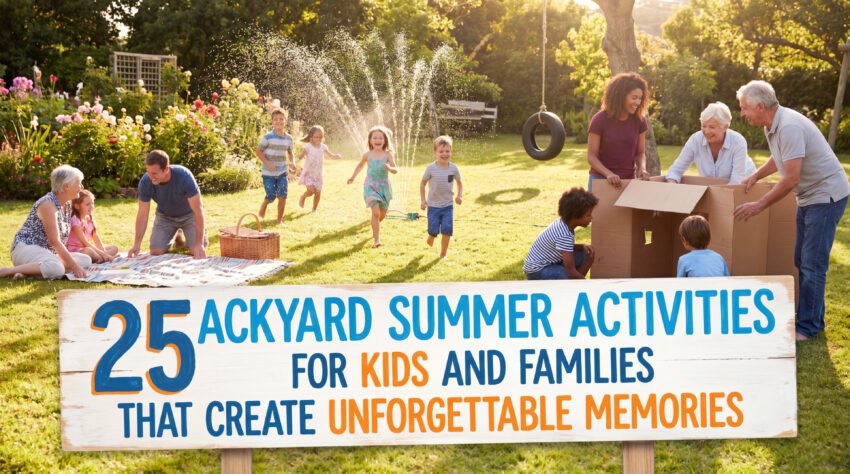
When the school year ends, the initial excitement of summer vacation is palpable. However, it rarely takes long for the novelty of free time to wear off, leading to restless energy and inevitable declarations of boredom. While screen time is an easy fallback, the backyard offers a superior alternative: a private, secure environment where children can expend energy, engage their imaginations, and hit critical developmental milestones.
Transforming your outdoor space into a hub of engaging summer activities does not require a massive budget or a landscape redesign. By strategically planning backyard summer activities, parents can create an environment that encourages independent play, physical fitness, and cognitive growth. This comprehensive guide details 25 high-value, easy-to-implement backyard activities designed to keep children entertained, active, and learning all summer long.
The Developmental Benefits of Outdoor Play
Before diving into specific activities, it is crucial to understand why unstructured outdoor play is essential for child development. Backyard activities offer far more than just a way to tire children out before bedtime; they are foundational to holistic growth.
Cognitive Growth and Problem Solving
Outdoor play naturally presents children with open-ended challenges. Whether they are figuring out how to balance stones, building a fort out of fallen branches, or designing an obstacle course, they are engaging in active problem-solving. This type of play requires spatial awareness, planning, and critical thinking. Unlike structured video games with predetermined rules, the backyard is a blank canvas that forces the brain to innovate.
Physical Health and Motor Skills
According to pediatric health guidelines, children need at least sixty minutes of moderate to vigorous physical activity daily. Backyard summer activities seamlessly integrate cardiovascular exercise with muscle strengthening. Running, jumping, climbing, and throwing improve gross motor skills, while activities like grasping chalk or manipulating small natural objects refine fine motor skills. Furthermore, navigating uneven outdoor terrain improves proprioception, which is the body’s ability to sense its location and movements.
Emotional Regulation and Sensory Engagement
Nature provides a rich sensory environment. The texture of grass, the temperature of water, and the sounds of wildlife stimulate a child’s sensory processing systems. Regular exposure to natural environments has been clinically shown to reduce cortisol levels, lowering stress and anxiety in children. Outdoor play also fosters resilience; falling down in the grass and getting back up teaches emotional regulation and perseverance.
High-Energy Backyard Summer Activities to Burn Energy
When the primary goal is cardiovascular exercise and burning off excess energy, structured physical challenges are highly effective. These activities are designed to keep children moving continuously while remaining highly engaging.
1. DIY Backyard Obstacle Courses
An obstacle course is one of the most versatile and physically demanding activities you can set up.
Setup Instructions
Use pool noodles, hula hoops, cardboard boxes, jump ropes, and patio cushions. Design a circuit with clear start and finish lines, incorporating balance beams made of wood planks and laser mazes made of string. Use a smartwatch or a digital stopwatch to time their runs.
Developmental Focus
Obstacle courses excel at developing sequential memory. Children must remember the order of operations for the course, while timing themselves builds intrinsic motivation and goal-setting skills.
2. The Sponge Relay Race
Summer heat requires activities that cool children down while keeping them active.
Setup Instructions
Place two full buckets of water at one end of the yard and two empty buckets at the other. Provide each team with a large car-washing sponge. Children must soak the sponge, run across the yard, and squeeze the water into the empty bucket until the first bucket is empty.
Developmental Focus
This activity heavily promotes cardiovascular stamina, speed, and teamwork, while the act of squeezing the large sponge develops grip strength.
3. Reusable Water Balloon Dodgeball
Traditional water balloons create plastic waste and require tedious cleanup. Invest in reusable magnetic water balloons made of soft silicone.
Setup Instructions
Set up designated safe zones in the yard using jump ropes as boundary lines. Place a bucket of water in the center to reload the balloons. Set a five-minute timer and let the children tag each other with the water balloons.
Developmental Focus
This fast-paced game improves hand-eye coordination, cardiovascular endurance, and spatial awareness as children actively dodge incoming throws.
4. Classic Backyard Olympics
Dedicate an entire afternoon to a structured Olympic event for siblings or neighborhood playdates.
Setup Instructions
Set up stations for standing broad jumps, wheelbarrow races, and three-legged races using a soft bandana. Keep a scoreboard on a piece of cardboard to track points or times for each event.
Developmental Focus
Friendly competition teaches emotional regulation and sportsmanship. Wheelbarrow races specifically build upper body strength, while three-legged races force communication and cooperative physical coordination.
5. Lawn Bowling with Recycled Bottles
A backyard variation of the classic indoor game that introduces physics concepts.
Setup Instructions
Fill ten empty plastic two-liter bottles with an inch of sand or water to weigh them down. Set them up in a triangle formation on a flat patch of grass or patio. Use a heavy rubber playground ball to roll and knock them down.
Developmental Focus
This refines targeting skills, hand-eye coordination, and introduces basic physics concepts like momentum, trajectory, and weight distribution.
6. Giant Bubble Making Station
Creating massive bubbles is visually stunning and requires full-body movement.
Setup Instructions
Mix a high-yield bubble solution using dish soap, water, and a small amount of glycerin. Build giant bubble wands using two wooden dowels and a loop of cotton string. Dip the string into a shallow tub of the solution and pull it through the air.
Developmental Focus
Chasing and popping these massive bubbles encourages running, jumping, and vertical reaching, which stretches core muscles and improves visual tracking.
7. Animal Walk Races
Transform a standard footrace by requiring specific, challenging body mechanics.
Setup Instructions
Mark a start and finish line. Call out different animals for each round: crab walks (hands and feet on the ground, chest facing up), bear crawls (hands and feet on the ground, hips high), and frog jumps.
Developmental Focus
These specific movements engage entirely different muscle groups than standard running, heavily promoting core stability, bilateral coordination, and gross motor strength.
8. Water Squirter Cup Races
A highly focused racing game that requires a steady hand.
Setup Instructions
Pierce a hole in the bottom of two plastic cups and thread a long piece of string through each. Tie the strings horizontally between two trees or fence posts. Children use water squirters to shoot water into the open cups, propelling them down the string to the finish line.
Developmental Focus
This activity requires intense visual focus, sustained grip strength, and the ability to maintain a steady aim under pressure.
Creative and Sensory Backyard Activities
Not all backyard summer activities need to be highly physical. Integrating art, science, and sensory exploration engages different areas of the brain and provides a calming counterbalance to high-energy games.
9. Nature Scavenger Hunts
A scavenger hunt forces children to observe their environment closely.
Setup Instructions
Create a list tailored to your specific region. Make the clues challenging (e.g., locate an insect with six legs, find a rock containing quartz, find a smooth leaf). Provide a magnifying glass, a clipboard, and a small bucket.
Developmental Focus
This activity teaches patience, scientific observation, and introduces basic taxonomy and environmental science categorization.
10. Ice Painting
A messy, outdoor-friendly art project that incorporates temperature play.
Setup Instructions
Fill an ice cube tray with water and add a few drops of washable liquid watercolors to each section. Insert a popsicle stick into each cube and freeze overnight. Roll out a large sheet of butcher paper on the lawn and let them paint as the ice melts.
Developmental Focus
This provides a cooling sensory experience, introduces color mixing theory, and allows for large-scale gross motor movements during the painting process.
11. Mud Kitchen Masterpieces
Dedicate a specific corner of the yard to profound sensory engagement.
Setup Instructions
Set up old pots, pans, wooden spoons, and measuring cups in a designated dirt area. Provide a watering can so children can mix soil, water, leaves, and pebbles to create “soups” and “pies.”
Developmental Focus
Mud play fosters imaginative role-play, introduces children to different textures, and routine exposure to soil microbes is linked to stronger immune system development.
12. Sensory Bins and Digging Zones
A controlled alternative to a full sandbox that develops critical motor skills.
Setup Instructions
Fill a large, shallow under-bed storage container with kinetic sand, dried beans, or water beads. Hide small plastic toys, imitation coins, or dinosaur bones inside. Provide scoops and tongs for excavation.
Developmental Focus
Using tongs to extract small items is highly effective for developing the pincer grasp, a vital fine motor skill required for handwriting and detailed tool use.
13. Fizzing Potion Station
An exciting introduction to basic chemical reactions.
Setup Instructions
Provide small plastic bowls, a box of baking soda, and squirt bottles filled with white vinegar dyed with food coloring. Allow children to mix the ingredients freely on the lawn to create colorful, fizzing “potions.”
Developmental Focus
This allows for open-ended, messy experimentation outdoors while introducing the scientific method through cause-and-effect observation.
14. Nature Weaving Loom
Creating organic art using items found strictly in the yard.
Setup Instructions
Cut a large rectangle out of sturdy cardboard and cut small slits along the top and bottom edges. String yarn tightly across the board to create a warp. Have children collect long blades of grass, dandelions, and fallen leaves to weave through the yarn.
Developmental Focus
Weaving develops extreme fine motor precision, bilateral hand coordination, and encourages an appreciation for natural textures and patterns.
15. Shadow Tracing
A simple activity that demonstrates the movement of the earth and sun.
Setup Instructions
On a sunny driveway or patio, have children place their favorite plastic animal toys or building blocks on a large sheet of paper. As the sun casts a shadow, have them trace the outline. Repeat this three times throughout the day.
Developmental Focus
This physically demonstrates how the earth’s rotation changes the sun’s angle and shadow length, merging art with foundational astronomy.
16. Outdoor Watercolor Tape Resist
Large-scale outdoor art that produces crisp, professional-looking results.
Setup Instructions
Use a roll of painter’s tape to create geometric patterns or spell out a child’s name on a large piece of heavy cardboard. Have them paint over the entire surface using vibrant watercolors. Once dry, peel the tape away to reveal the negative space.
Developmental Focus
This encourages spatial planning, teaches the concept of negative space in art, and allows for uninhibited brush strokes.
Educational and Nature-Based Activities
The backyard is an ecosystem ripe for exploration. These activities disguise scientific observation and critical thinking as play.
17. DIY Bird Feeders
Encouraging local wildlife observation right outside your window.
Setup Instructions
Collect large pinecones from the yard. Tie a string around the top, coat the pinecone in a layer of peanut butter (or a seed butter alternative), and roll it in mixed birdseed. Hang these from low tree branches.
Developmental Focus
This teaches children about the dietary habits of regional bird species and instills a sense of environmental stewardship.
18. Seed Planting and Germination Station
Giving children ownership over the life cycle of a living thing.
Setup Instructions
Provide children with a small patch of dirt or a few terracotta pots. Have them plant fast-growing seeds like radishes, green beans, or sunflowers. Assign them the daily responsibility of watering the soil.
Developmental Focus
The routine of caring for a plant introduces biological life cycles, delayed gratification, and instills a deep sense of responsibility.
19. DIY Rain Gauge Observation
Turning summer storms into an opportunity for data collection.
Setup Instructions
Cut the top off a clear plastic water bottle and invert it into the base to create a funnel. Use a permanent marker and a ruler to mark inch and half-inch increments on the side. Place it in an open area of the yard before a storm.
Developmental Focus
Children can measure and chart the rainfall, introducing basic meteorological data collection, chart creation, and mathematical measurement.
20. Backyard Bug Safari
Building an appreciation for micro-ecosystems.
Setup Instructions
Equip children with a dedicated bug-catching container with air holes, a magnifying glass, and a regional insect identification book. Challenge them to carefully catch, observe, identify, and then release different insects.
Developmental Focus
This teaches the ethical, gentle handling of living creatures, observational patience, and scientific classification skills.
21. Story Stones Painting
A craft that doubles as a literacy and narrative development tool.
Setup Instructions
Collect smooth, flat river rocks. Have children paint different images on them (a sun, an animal, a car). Once dry, place all the stones in a bag. Children take turns pulling out a stone and adding a sentence to a collaborative story based on the image.
Developmental Focus
This activity heavily promotes narrative sequencing, verbal creativity, improvisational thinking, and cooperative storytelling.
Evening and Nighttime Backyard Activities
The backyard remains a valuable resource even after the sun goes down. Evening activities take advantage of cooler temperatures and introduce children to a completely different atmospheric environment.
22. Musical Flashlight Tag
A thrilling variation of traditional tag incorporating sound and light.
Setup Instructions
Set up a wireless outdoor speaker playing upbeat music. The person who is “it” uses a flashlight beam to tag runners. When the music pauses, everyone must freeze in place; anyone caught moving by the flashlight beam is out.
Developmental Focus
This enhances auditory processing, rapid physical inhibition (freezing on cue), and spatial awareness in low-light environments.
23. Backyard Stargazing and Astronomy
A calm, educational way to wind down before bed.
Setup Instructions
Lay a waterproof blanket on the grass. Download a free augmented reality astronomy app on a smartphone or tablet. Point the device at the sky to map out constellations and planets in real-time.
Developmental Focus
Discussing the scale of the solar system introduces foundational physics, spatial reasoning on a macro scale, and technological literacy via the AR application.
24. Glow-in-the-Dark Ring Toss
Testing physical accuracy in the dark.
Setup Instructions
Crack and activate several glow stick necklaces and bracelets. Push a sturdy wooden stick or a plastic stake into the lawn. In the dark, children take turns throwing the glowing rings onto the stake.
Developmental Focus
This tests depth perception, hand-eye coordination, and distance estimation in a visually restricted environment.
25. Outdoor Movie Nights
Recreating the magic of a drive-in theater at home.
Setup Instructions
Use a portable projector and project a family-friendly movie onto the side of the house or a suspended white bedsheet. Bring out sleeping bags, floor cushions, and popcorn to create a cozy viewing area.
Developmental Focus
While passive, this serves as a critical bonding activity, encourages narrative comprehension, and helps children transition into a calm state for sleep after a highly active day.
Essential Equipment for a Summer-Ready Backyard
While many activities require only common household items, curating a specific inventory of outdoor play tools can drastically expand your options. Focus on durable, open-ended items rather than single-use toys.
Must-Have Physical Activity Gear
-
Cones and Spot Markers: Essential for creating boundaries, setting up goals, and marking relay stations.
-
Various Balls: Maintain a stock of soccer balls, tennis balls, and lightweight bouncy balls to accommodate different games and skill levels.
-
Jump Ropes: An inexpensive tool that promotes cardiovascular health, rhythm, and bilateral coordination.
-
Sidewalk Chalk: Crucial for drawing four-square courts, hopscotch grids, or temporary start and finish lines on patios or driveways.
Creative and Sensory Tools
-
Magnifying Glasses and Bug Catchers: Encourage scientific observation of local ecology.
-
Washable Paints and Butcher Paper: Facilitate large-scale outdoor art projects without the stress of indoor messes.
-
Heavy-Duty Storage Bins: Useful for housing sensory materials like water, sand, or ice, and keeping the yard organized when not in use.
Safety Tips for Summer Backyard Play
Maximizing fun requires a strict adherence to basic safety protocols, particularly regarding weather and environmental factors.
Hydration and Sun Protection
Children often ignore their body’s thirst signals when highly engaged in play. Establish mandatory water breaks every thirty minutes. Set up a designated hydration station outside with a large insulated water jug and reusable cups so they do not have to enter the house. Apply a broad-spectrum sunscreen with an SPF of at least 30 thirty minutes prior to outdoor play, and reapply every two hours, or immediately after water-based activities.
Equipment Safety Checks
Routinely inspect the backyard for new hazards. Check wooden play structures for splinters or loose bolts. Ensure that hoses are neatly coiled to prevent tripping. If utilizing water activities, empty all buckets and kiddie pools immediately after use; even a few inches of standing water poses a severe drowning hazard for toddlers and acts as a breeding ground for mosquitoes.
Frequently Asked Questions (FAQs)
How can I keep kids entertained outside for hours without intervening?
The key to sustained independent play is rotating activities and providing open-ended tools. Do not put all the backyard toys out at once. Introduce the obstacle course on Monday, the mud kitchen on Wednesday, and the water games on Friday. Additionally, initiate an activity by playing with them for the first ten minutes. Once they are fully engaged in the narrative or the physical challenge, you can step back and allow their imagination to take over.
What are the best inexpensive backyard activities?
The most cost-effective activities utilize nature and upcycled household items. Nature scavenger hunts, mud kitchens, and obstacle courses built from cardboard boxes and garage items cost nothing. Sidewalk chalk, homemade bubble solution, and recycled plastic bottle bowling are very low-cost investments that yield high returns in terms of entertainment duration.
How do I protect my lawn with high outdoor traffic?
Heavy summer use can lead to soil compaction and dead grass patches. To mitigate this, rotate the play zones frequently. Do not leave the kiddie pool or the slip-and-slide in the same spot for more than two days, as it will suffocate the grass beneath it. Encourage varied activities that utilize the entire yard rather than concentrating foot traffic in a single area. Water the lawn deeply in the early mornings to help it recover from heavy daytime use.
At what age is unstructured backyard play safe?
The required level of supervision scales with the child’s age. Toddlers (ages 1-3) require constant, arm’s-length supervision due to choking hazards and lack of hazard awareness. Preschoolers (ages 4-5) can play more independently but require a parent to be visually present in the yard. School-aged children (ages 6+) can generally play independently in a secure, fenced backyard while a parent monitors periodically from an indoor window, provided the yard is fully hazard-proofed.
How do I handle bugs and mosquitoes during evening activities?
Eliminate standing water in the yard to disrupt mosquito breeding cycles. During evening activities like stargazing or flashlight tag, use a child-safe insect repellent containing DEET or Picaridin. Alternatively, set up outdoor oscillating fans; mosquitoes are weak flyers, and a strong breeze will effectively keep them away from the play area.
Conclusion
Maximizing the potential of your outdoor space is the ultimate strategy for navigating the long months of school vacation. By implementing a diverse mix of high-energy games, educational sensory experiences, and creative nighttime activities, you ensure that your children remain physically active and mentally stimulated.
Successful backyard summer activities do not rely on expensive equipment; they rely on consistency, creativity, a willingness to embrace a little mess, and a focus on developmental milestones. By structuring your backyard to support varied, independent play, you are providing your children with an environment where they can build resilience, hone their problem-solving skills, and create lasting childhood memories right outside your back door.