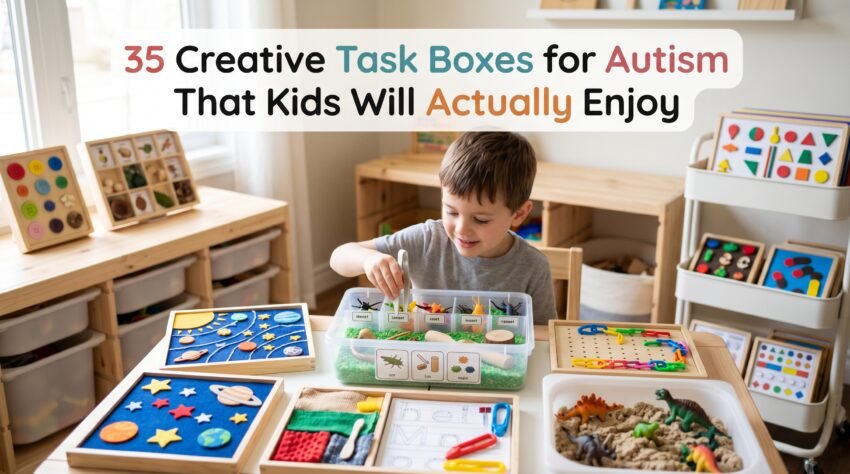
Children learn in different ways, and for many autistic learners, structure, predictability, and visual organization can make learning more accessible and less overwhelming. One of the most effective tools used in autism classrooms, therapy settings, and homes is the task box.
Task boxes are simple, structured learning activities placed inside containers that children complete independently or with minimal guidance. They break skills into manageable steps and create clear expectations, helping children focus on one activity at a time. Parents, teachers, and therapists often use task boxes to build independence, support attention, strengthen fine motor skills, teach academic concepts, and develop life skills.
The best part is that task boxes do not need expensive materials or complicated preparation. Many can be created with household items and adapted to different ages and ability levels. This guide covers what task boxes for autism are, why they work, how to set them up, and 35 practical task box ideas for home and classroom use.
What Are Task Boxes for Autism?
Task boxes are structured activities organized inside containers, trays, folders, or boxes that encourage children to complete one clearly defined task at a time.
Each task box usually includes:
- Materials needed for one activity
- Clear beginning and ending points
- Visual organization
- Simple instructions
- Independent completion opportunities
Task boxes are commonly used to teach:
- Fine motor skills
- Matching
- Sorting
- Literacy
- Math
- Daily living skills
- Communication
- Executive functioning
Many autistic learners benefit from this structured format because it reduces distractions and supports routine.
Why Task Boxes Work for Autistic Learners
Task boxes are effective because they align with common learning strengths found in many autistic children.
Predictability Reduces Stress
Structured tasks help children understand expectations and reduce uncertainty.
Encourages Independent Learning
Children practice completing activities without constant adult prompting.
Improves Attention and Focus
Single-task activities help reduce overload and improve concentration.
Supports Visual Learning
Visual boundaries and organized materials often improve understanding.
Builds Confidence
Completing tasks independently creates a sense of accomplishment.
How to Create a Task Box System
A successful task box system should remain simple and predictable.
Step 1: Start With Familiar Skills
Begin with activities the child already understands.
Step 2: Use Clear Containers
Choose bins, boxes, trays, or folders.
Step 3: Keep Instructions Visual
Use pictures, color coding, or examples.
Step 4: Limit Materials
Avoid clutter or overwhelming setups.
Step 5: Rotate Activities
Introduce new boxes gradually.
Fine Motor Task Boxes
These activities strengthen hand muscles and coordination.
1. Pom-Pom Transfer Box
Materials Needed
- Pom-poms
- Tongs
- Two containers
Skills Developed
- Hand strength
- Coordination
- Focus
Autism Adaptation Tip
Use favorite colors to increase engagement.
2. Clothespin Matching Box
Materials Needed
- Clothespins
- Color cards
Skills Developed
- Pinching strength
- Color recognition
3. Bead Threading Box
Materials Needed
- Large beads
- Thick string
Skills Developed
- Bilateral coordination
- Fine motor control
4. Coin Drop Box
Materials Needed
- Container with slot
- Plastic coins
Skills Developed
- Precision
- Visual coordination
5. Sponge Squeezing Box
Materials Needed
- Water bowl
- Sponges
Skills Developed
- Hand strength
- Sensory regulation
6. Opening Containers Box
Materials Needed
- Various containers
- Small objects
Skills Developed
- Finger strength
- Independence
7. Velcro Matching Box
Materials Needed
- Picture cards
- Velcro strips
Skills Developed
- Matching
- Visual attention
Matching and Sorting Task Boxes
Sorting activities develop visual discrimination and organization skills.
8. Shape Sorting Box
Materials Needed
- Shape pieces
- Containers
Skills Developed
- Sorting
- Spatial awareness
9. Color Sorting Box
Materials Needed
- Colored objects
- Matching bowls
Skills Developed
- Categorization
- Visual processing
10. Animal Matching Box
Materials Needed
- Toy animals
- Matching cards
Skills Developed
- Vocabulary
- Recognition
11. Size Sorting Box
Materials Needed
- Objects of different sizes
Skills Developed
- Comparison
- Classification
12. Texture Matching Box
Materials Needed
- Fabric samples
Skills Developed
- Sensory awareness
13. Picture Matching Box
Materials Needed
- Duplicate picture cards
Skills Developed
- Memory
- Visual attention
14. Household Object Sorting Box
Materials Needed
- Everyday objects
Skills Developed
- Categorization
- Functional understanding
Literacy Task Boxes
Literacy activities can support language and communication.
15. Letter Matching Box
Materials Needed
- Foam letters
- Letter cards
Skills Developed
- Letter recognition
16. Beginning Sounds Box
Materials Needed
- Picture cards
- Alphabet labels
Skills Developed
- Phonemic awareness
17. Sight Word Box
Materials Needed
- Word cards
- Matching labels
Skills Developed
- Reading fluency
18. Sequencing Story Box
Materials Needed
- Story picture cards
Skills Developed
- Comprehension
- Organization
19. Name Building Box
Materials Needed
- Letter tiles
Skills Developed
- Identity recognition
- Literacy
20. Sentence Building Box
Materials Needed
- Word strips
Skills Developed
- Language structure
Math Task Boxes
Math activities support early numeracy and logical thinking.
21. Counting Clip Box
Materials Needed
- Number cards
- Clothespins
Skills Developed
- Counting
- Fine motor control
22. Number Matching Box
Materials Needed
- Number cards
- Counters
Skills Developed
- Number recognition
23. Ten Frame Box
Materials Needed
- Counters
- Ten-frame boards
Skills Developed
- Number concepts
24. Pattern Building Box
Materials Needed
- Colored blocks
Skills Developed
- Sequencing
25. Simple Addition Box
Materials Needed
- Counting objects
Skills Developed
- Basic math skills
Sensory Task Boxes
Sensory-based activities support engagement and exploration.
26. Rice Scoop Box
Materials Needed
- Rice
- Scoops
Skills Developed
- Sensory regulation
27. Texture Exploration Box
Materials Needed
- Various materials
Skills Developed
- Tactile awareness
28. Sensory Search Box
Materials Needed
- Hidden objects
Skills Developed
- Attention
29. Kinetic Sand Box
Materials Needed
- Kinetic sand
- Tools
Skills Developed
- Fine motor skills
30. Water Transfer Box
Materials Needed
- Cups
- Water
Skills Developed
- Coordination
Life Skills Task Boxes
Life skills build independence and functional abilities.
31. Sock Matching Box
Materials Needed
- Socks
Skills Developed
- Organization
32. Folding Towels Box
Materials Needed
- Hand towels
Skills Developed
- Daily living skills
33. Utensil Sorting Box
Materials Needed
- Plastic utensils
Skills Developed
- Categorization
34. Packaging Task Box
Materials Needed
- Small bags
- Objects
Skills Developed
- Work readiness
35. Snack Preparation Box
Materials Needed
- Safe snack items
Skills Developed
- Independence
- Sequencing
How to Adapt Task Boxes for Different Ages
Preschool Learners
Focus on:
- Matching
- Fine motor
- Simple sorting
Elementary Students
Focus on:
- Literacy
- Math
- Following routines
Older Students
Focus on:
- Life skills
- Independent work
- Functional tasks
Tips to Prevent Task Box Frustration
Keep Tasks Short
Short activities improve success.
Start Easy
Build confidence first.
Use Interests
Include favorite themes.
Provide Visual Supports
Pictures and labels improve understanding.
Celebrate Completion
Focus on effort and progress.
DIY Budget-Friendly Task Box Materials
You do not need expensive supplies.
Easy materials include:
- Shoeboxes
- Plastic bins
- Clothespins
- Pom-poms
- Velcro
- Plastic eggs
- Index cards
- Recycled containers
Common Mistakes to Avoid
Avoid:
- Making tasks too difficult
- Including too many materials
- Changing routines constantly
- Giving unclear instructions
- Overloading sensory input
Simple, predictable systems usually work best.
Frequently Asked Questions
What are task boxes for autism?
Task boxes are structured activities designed to support independent learning through clear, organized tasks.
Why are task boxes effective?
They reduce distractions, support visual learning, and encourage independence.
What age are task boxes for?
Task boxes can be adapted for preschoolers, school-age children, teens, and even adults.
Can task boxes be used at home?
Yes. Many families use task boxes for daily routines, learning activities, and independent play.
How many task boxes should children complete?
Start with one or two boxes and increase gradually based on attention and success.
Do task boxes need special materials?
No. Most task boxes can be created using inexpensive household items.
Conclusion
Task boxes for autism provide a practical and flexible way to support independent learning, reduce overwhelm, and build meaningful skills. By breaking activities into clear, manageable steps, task boxes help autistic learners experience success while strengthening attention, confidence, and daily functioning.
Whether you use fine motor activities, literacy tasks, sensory experiences, or life skills practice, task boxes can be adapted to meet different ages, interests, and developmental needs.
With a simple setup and thoughtful organization, task boxes can become a valuable tool for creating structured, engaging, and supportive learning experiences at home or in the classroom.