Introduction
Autism spectrum disorder (ASD) is often described as a spectrum because no two individuals experience it in exactly the same way. Some people live independently with minimal support, while others require significant daily assistance. To better understand these differences, clinicians use a structured system known as “levels of autism.”
If you have come across terms like Level 1, Level 2, or Level 3 autism, you may be wondering what they actually mean in real life. Are they labels of severity? Do they reflect intelligence? Can they change over time?
This guide explains autism levels in a clear, practical, and evidence-informed way. You will learn how the levels are defined, what each level looks like in daily life, and how they guide support and intervention decisions.
What Are the Levels of Autism?
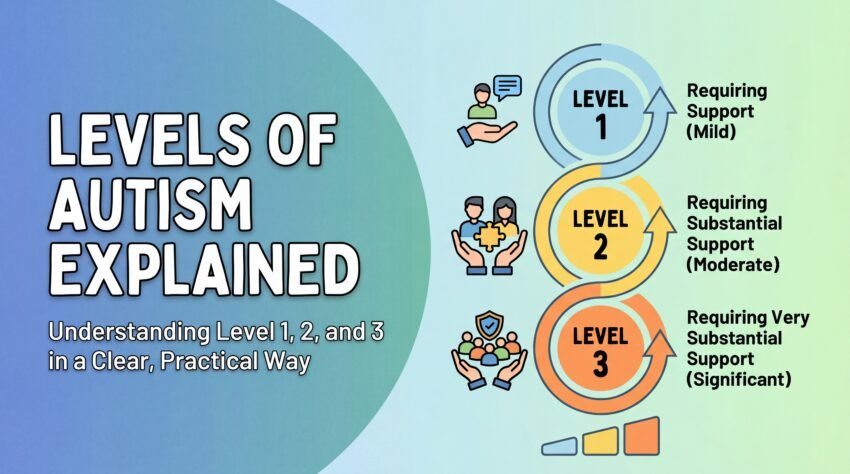
Autism levels are part of the diagnostic framework outlined in the DSM-5 (Diagnostic and Statistical Manual of Mental Disorders, Fifth Edition). They categorize autism into three levels based on the amount of support an individual needs in daily life.
- Level 1: Requiring support
- Level 2: Requiring substantial support
- Level 3: Requiring very substantial support
These levels are not about intelligence or worth. They are used to describe how much assistance a person needs with communication, behavior, and daily functioning.
Why Autism Has Different Levels
Autism is not a single, uniform condition. It affects people differently in two main areas:
Social Communication
This includes:
- Understanding social cues
- Engaging in conversations
- Building relationships
Some individuals may have mild challenges, while others may have very limited communication abilities.
Restricted and Repetitive Behaviors
These may include:
- Repetitive movements
- Strong routines
- Sensory sensitivities
The intensity of these behaviors varies widely.
Because of these differences, the level system helps professionals tailor support to each individual’s needs rather than applying a one-size-fits-all approach.
The Three Levels of Autism Explained
Level 1 Autism: Requiring Support
Level 1 is often considered the least intensive in terms of support needs, but that does not mean the challenges are insignificant.
Key Characteristics
- Difficulty initiating social interactions
- Challenges with back-and-forth conversations
- Preference for routines and structure
- Difficulty switching between tasks
Real-Life Example
A child with Level 1 autism may do well academically but struggle to make friends. They might find group conversations confusing or overwhelming and prefer to play alone or with familiar peers.
An adult may hold a job but find workplace social dynamics challenging, such as understanding sarcasm or reading body language.
Support Needs
- Social skills training
- Structured routines
- Support during transitions
- Coaching in communication strategies
Level 1 individuals can often live independently with the right support systems in place.
Level 2 Autism: Requiring Substantial Support
Level 2 autism involves more noticeable challenges that require consistent support.
Key Characteristics
- Limited verbal or nonverbal communication
- Difficulty coping with change
- More obvious repetitive behaviors
- Reduced ability to initiate social interactions
Real-Life Example
A child with Level 2 autism may use short phrases to communicate and struggle to engage in typical classroom activities without assistance. Changes in routine, such as a substitute teacher, may lead to distress.
An adult may require support in employment settings and may find independent living difficult without assistance.
Support Needs
- Speech and language therapy
- Behavioral interventions
- Structured environments
- Assistance with daily routines
Individuals at this level benefit from consistent guidance and structured support systems.
Level 3 Autism: Requiring Very Substantial Support
Level 3 autism represents the highest level of support needs.
Key Characteristics
- Severe communication challenges (may be nonverbal)
- Significant difficulty with daily living tasks
- Intense repetitive behaviors
- Strong resistance to change
Real-Life Example
A child with Level 3 autism may not use spoken language and may rely on alternative communication methods such as pictures or devices. They may need assistance with basic daily activities like eating or dressing.
An adult may require full-time support for daily living and may have limited independence.
Support Needs
- Intensive therapy and intervention
- Full-time caregiver support
- Specialized education programs
- Assistive communication tools
Level 3 individuals often need ongoing, comprehensive support to navigate daily life.
Autism Levels Comparison Table
| Feature | Level 1 | Level 2 | Level 3 |
|---|---|---|---|
| Support Needed | Minimal to moderate | Substantial | Very substantial |
| Communication | Mild difficulty | Limited | Severe or minimal |
| Social Interaction | Awkward but possible | Reduced and inconsistent | Very limited |
| Independence | Mostly independent | Needs regular support | Highly dependent |
| Flexibility | Struggles with change | Significant difficulty | Extreme difficulty |
Key Differences Between Autism Levels
Support Needs vs Severity
The levels describe how much support a person needs—not how “severe” they are as a person. Two individuals at the same level can have very different abilities.
Communication Differences
- Level 1: Can communicate but may struggle socially
- Level 2: Limited communication abilities
- Level 3: Minimal or no verbal communication
Behavioral Differences
Repetitive behaviors and resistance to change become more pronounced as support needs increase.
What Autism Levels Do Not Mean
Understanding what these levels do not represent is just as important.
They Do Not Measure Intelligence
Autism can occur across all intelligence levels. Some individuals may have average or above-average intelligence regardless of their level.
They Are Not Fixed Labels
Autism levels can change over time, especially with early intervention and support.
They Do Not Define Potential
A person’s abilities, talents, and personality go far beyond their diagnostic level.
Can Autism Levels Change Over Time?
Yes, autism levels are not permanent. With appropriate support, therapy, and environmental adjustments, individuals may require less support over time.
For example:
- A child diagnosed at Level 2 may move toward Level 1 with intervention
- Skills such as communication and independence can improve
However, changes vary from person to person, and progress should not be compared across individuals.
What Autism Levels Mean for Daily Life
In School
- Level 1: May need minimal classroom support
- Level 2: Requires structured teaching and assistance
- Level 3: Needs specialized education programs
In Social Settings
- Level 1: Difficulty with social nuance
- Level 2: Limited interaction
- Level 3: Minimal engagement
In Daily Living
- Level 1: Independent with minor support
- Level 2: Needs help with routines
- Level 3: Requires full assistance
How Autism Levels Are Diagnosed
Diagnosis is conducted by qualified professionals such as psychologists or developmental specialists.
The Process Includes
- Behavioral observation
- Developmental history
- Standardized assessments
- Input from caregivers and teachers
Clinicians evaluate:
- Social communication skills
- Behavioral patterns
- Level of independence
Based on this, they assign a level that reflects support needs.
Common Misconceptions About Autism Levels
“Level 1 Means Mild Autism”
While often described as “mild,” Level 1 can still involve significant challenges, especially in social and professional environments.
“Level 3 Means No Ability”
Individuals at Level 3 may have strengths and ways of communicating that are not immediately obvious.
“All Individuals Fit Neatly Into One Level”
In reality, abilities can vary across different areas, making classification more complex.
FAQs About Autism Levels
What is the mildest level of autism?
Level 1 is considered the least intensive in terms of support needs, but it still involves meaningful challenges.
Is Level 3 autism severe?
Level 3 indicates the highest level of support needs, particularly in communication and daily functioning.
Can a child move from Level 3 to Level 1?
In some cases, individuals show significant improvement with therapy and support, but outcomes vary.
Are autism levels used worldwide?
They are widely used in clinical settings that follow DSM-5 guidelines, though terminology may vary by region.
Why were “high-functioning” and “low-functioning” labels removed?
These terms were considered oversimplified and sometimes misleading. The level system provides a more accurate description of support needs.
Conclusion
Understanding the levels of autism is essential for providing the right kind of support. Rather than labeling individuals, these levels serve as a guide for identifying needs and tailoring interventions.
Level 1, Level 2, and Level 3 each represent different degrees of support required in areas like communication, behavior, and daily living. However, they do not define intelligence, potential, or personal identity.
The most important takeaway is that autism is highly individual. With the right support, environment, and understanding, individuals across all levels can develop skills, build meaningful connections, and lead fulfilling lives.
By focusing on strengths as well as challenges, caregivers and professionals can create supportive pathways that empower individuals with autism to thrive.